Film Review
A curiosity from the silent era of film,
Salome feels more like a bizarre
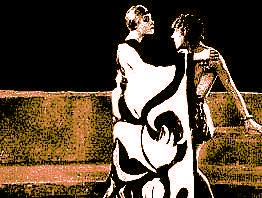
Art Nouveau-inspired erotic dream than a piece of cinema. The
extravagant costumes, striking minimalist set design and
highly stylised acting suggest narcotic-induced fantasy, not
realism. Whilst the film's effete artificiality and sluggish pace
are somewhat off-putting, these are outweighed by its sheer novelty
value - it is a work of visual poetry which tacitly defies
categorisation and for which there is no comparable benchmark. It
is a "one off", in the strictest sense of the term, and a treat for any
admirer of experimental cinema.
The star of the film is Alla Nazimova, a flamboyant Russian-born actress
of stage and screen who, in her day, was almost as famous as Sarah
Bernhardt. Although in her early-40s when she played the part of
Salome, Nazimova manages to suggest a beguiling mix of childlike naivety and
daring sensuality. It's a pity that her gestures are so grossly
exaggerated, and her dance of the seven veils is, it has to
be said, pretty lamentable. The film was financed by
Nazimova (almost bankrupting her) and she directed the film
under the name of her husband, Charles Bryant.
The film is an adaptation of the highly controversial play by Oscar
Wilde (whose initial stage production in London was banned for being
judged blasphemous). The marvellous illustrations by Aubrey Beardsley
for the first English edition (1894) of Wilde's play provided the
inspiration for the film's distinctive art design.
© James Travers 2008
The above content is owned by frenchfilms.org and must not be copied.
Film Synopsis
Salome is the young stepdaughter of Herod, the tyrannical Tetrarch of
Judea who murdered his brother to usurp both his throne and his
wife. The beautiful Salome is an object of desire for both Herod
and his guard captain, but she is interested only in Jokaanan, a Syrian
prophet whom Herod has imprisoned. Against the king's edict,
Salome has Jokaanan brought to her so that she can seduce him, but he
rejects her advances and returns voluntarily to his cell. When
Herod asks Salome to dance for him, she agrees, but on one condition...
© James Travers
The above content is owned by frenchfilms.org and must not be copied.