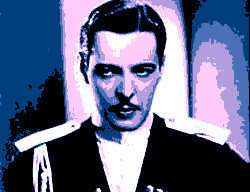
The Gay Diplomat (1931) Directed by Richard Boleslawski
Drama
Film Review
The Gay Diplomat was one of
the first films to be made in Hollywood by the Polish-born filmmaker
Richard Boleslawski. Saddled with a third rate script and a
second rate cast, Boleslawski is visibly struggling to make this
humdrum tale of espionage in Imperial Russia remotely interesting, and
apart from a few striking montage sequences (an obvious nod to
Eisenstein) the film is distinctly lacking in style and momentum.
Having very little in the way of star charisma and
acting ability, Ivan Lebedeff is ill-equipped to carry the film as the
dashing spycatcher, and our attention cannot help being drawn to his
far more capable co-stars, Genevieve Tobin and Betty Compson, who
should both have enjoyed far more success than they did. After
this clumsy misfire, Boleslawski went on to become a well-regarded
director in Hollywood and worked on some prestige productions with some
of the biggest stars of the day, including John Barrymore (Rasputin and the Empress, 1932),
Clark Gable (Men in White,
1934), Greta Garbo (The Painted Veil,
1934), Fredric March (Les
Misérables, 1935) and Marlene Dietrich (The Garden of Allah, 1936).
The above content is owned by frenchfilms.org and must not be copied.
Film Synopsis
Captain Orloff, a young officer in the Russian infantry, is sent to
Bucherest on a vital mission: to uncover an enemy agent who is believed
to be a woman. On the way to his destination, Orloff falls under
the spell of the Countess Diana Dorchy - the attraction appears to be
mutual. In Buchrest, Orloff is surprised to renew his
acquaintance with the countess. Is it possible that she is the
spy he is to ensnare...?
Cast: Ivan Lebedeff (Captain Ivan Orloff),
Genevieve Tobin (Countess Diana Dorchy), Betty Compson (Baroness Alma Corri), Ilka Chase (Madame Blinis), Purnell Pratt (Colonel George Gorin), Rita La Roy (Natalie, the Maid),
Colin Campbell (Gamble, the Valet),
Edward Martindel (Ambassador), Arthur Edmund Carewe (Suave Man),
Adolph Faylauer (Ball Extra),
George Irving (Colonel),
William H. O'Brien (Room Waiter),
John St. Polis (General), Onslow Stevens (Lieutenant),
Judith Vosselli (Wife),
Harry Wilson (Footman)
Country: USA
Language: English
Support: Black and White
Runtime: 66 min
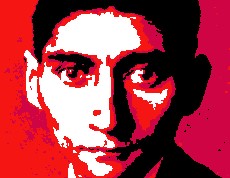
Kafka's tortuous trial of love
Franz Kafka's letters to his fiancée Felice Bauer not only reveal a soul in torment; they also give us a harrowing self-portrait of a man appalled by his own existence.
In his letters to his friends and family, Franz Kafka gives us a rich self-portrait that is surprisingly upbeat, nor the angst-ridden soul we might expect.