Film Review
Tony Gatlif's longstanding fascination with travelling communities - in particular
the Romany gypsies - has allowed him to carve a highly idiosyncratic niche
in French cinema that has earned him international recognition. Since
the early 1980s, Gatlif has provided colourful insights into the various
nomadic cultures across the world, his vibrant use of visuals and traditional
music taking us right into the heart of ways of living that are breathtakingly
alien to virtually all westerners. Even when his films are patently
lacking in narrative substance and strong central characters, they are still
beguiling, suffused with a raw humanity and lyricism that is hard to resist.
Coming in the wake of the well-received and masterfully crafted
Exils (2004),
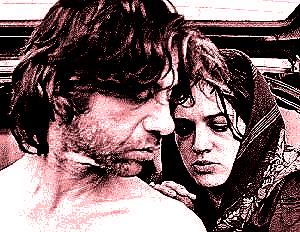
Transylvania immediately
strikes you as a lesser work. There is next to nothing in the way of
plot, just a free-flowing narrative that feels like nothing more than a touristy
random walk through a foreign culture. As photogenic as she is, the
lead actress Asia Argento tends to get lost amid the cultural overload that
Gatlif feels impelled to share with us, and what the director delivers feels
like a somewhat half-hearted attempt to hammer a first-person perspective
onto a poorly defined ethnographic documentary.
For the most part,
Transylvania can't help looking like an over-stuffed
compilation of Gatlif's earlier work -
Latcho Drom (1993),
Gadjo dilo (1997) and
Vengo
(2000) - without achieving the sublime artistic coherence of these enchanting
films. Yet despite its frustrating lack of focus and direction, Gatlif's
Transylvanian odyssey does have something of the charm and mesmerising quality
of the director's previous screen offerings. The warmth of the people
he films with such genuine respect and affection is effectively contrasted
with the austere froideur of the inclement Rumanian landscape. If anything,
the gossamer-like storyline about an Italian girl's quest for love gets in
the way of Gatlif's attempts to connect us with a fascinating foreign people.
Transylvania is more a zanily thrown together collage of sound and
sight from exotic climes than a conventional piece of cinema - one where
unfamiliar customs (including a milk-dowsing exorcism and other pagan ceremonies)
frolic with even more bizarre human interactions to confound our senses,
humorously challenging our notion of normality. It is a demanding
piece for anyone unfamiliar with Gatlif's distinctive work, and without the
presence of a Romain Duris to provide a solid point of connection it's pretty
hard-going even for the most ardent fans of this director. However,
as a statement of the seductive power of an alien culture it is highly effective,
and only a soulless vampire would fail to be seduced by the beautifully shot
vistas that Gatlif captures with such guileless artistry.
© James Travers 2022
The above content is owned by frenchfilms.org and must not be copied.
Film Synopsis
On discovering she is pregnant, a young Italian woman named
Zingarina makes up her mind to find the man, Milan Augustin, who put her
in this unfortunate condition. The couple were passionately in love,
until one day Milan abruptly ended the affair and went off in search of pastures
new in Transylvania. Accompanied by her best friend Marie and a friendly
interpreter Luminitsa, Zingarina leaves her home in France and begins her
Transylvanian quest in earnest, determined to bring about a reconciliation
with the man she still loves to distraction.
Unfortunately, Milan's feelings have not altered one iota since he abandoned
his pregnant girlfriend and Zingarina's attempts to win him back prove totally
futile. Acting on impulse. the desolate young woman ditches her travelling
companions and hooks up with an itinerant gypsy girl. As she strays
further into this strange and beguiling land, Zingarina becomes increasingly
enchanted by the unusual customs and habits of all those she encounters.
She soon develops a close rapport with a travelling merchant named Tchangalo,
cementing her love for a country and people unlike any she has ever known...
© James Travers
The above content is owned by frenchfilms.org and must not be copied.